
What a dilapidation report is
A dilapidation report (sometimes called a condition report or a pre-construction survey) documents the existing condition of a building and its surrounds at a fixed point in time. It is not an assessment of whether the building is sound, and it is not a building inspection in the pre-purchase sense. It is evidence: a set of dated photographs and written notes, organised element by element, that says “this is exactly what was here on this date, before the works next door began.”
The word itself is old-fashioned (dilapidation means a state of disrepair), which is why buyers and neighbours often search for the meaning before they search for the service. In practice the report is used far more to prove that damage did happen than to record disrepair that already existed.
Why you’d need one in NSW
There are 3 people who need the same document, for 3 different reasons.
- The builder, owner-builder or developer with a DA condition.Sydney councils routinely make a dilapidation report of the adjoining properties a condition of development consent before excavation, demolition, piling or any work that sends vibration into the ground. Read the consent: it names the properties and sometimes the council’s own assets (kerb, footpath, road) as well.
- The neighbour.If the excavator next door cracks your render or drops your fence, the report is the proof that the crack was not there on the day before. Without it, it is your word against the builder’s, and the builder has an insurer.
- The builder, again, as protection.A pre-existing crack that is documented cannot be claimed against the works. The report protects the person doing the work from the neighbour’s 20-year-old settlement crack as surely as it protects the neighbour from the new one.
What a dilapidation report includes
Element by element, inside and out, with a photograph and a note on each. A report to this standard typically covers:
- External elements: walls, render, brickwork and mortar, the roof, gutters and eaves, windows and doors and their operation, external steps and verandahs.
- Internal elements: walls, ceilings and cornices in every room, floors and floor coverings, tiles, door and window operation, built-in joinery where it meets the walls.
- Other structures: fences, driveways, paths, retaining walls, pools and their surrounds, garden walls and landscaping features.
The thing that makes a report useful 6 months later is not the number of photographs. It is whether each one can be located again. A close-up of a hairline crack with nothing else in frame is almost worthless in a dispute, because nobody can prove which wall it was on. A good report photographs the room, then the wall, then the crack, with a scale reference and the date in frame, so the post-construction comparison is unarguable. That is how we shoot them, and it is the question to ask any inspector you are considering.
Drone, thermal camera and moisture meter on every inspection, at no extra charge.On a dilapidation report the drone earns its place twice: the roof is the element most likely to be damaged by vibration and the hardest to prove without a before photograph, and the rear and side elevations of a neighbour’s house are often invisible from anywhere you are allowed to stand.
Works Starting Next Door? Get The Record First.
A dated, photographed report the same day. A firm price before anything is booked.
When to get one
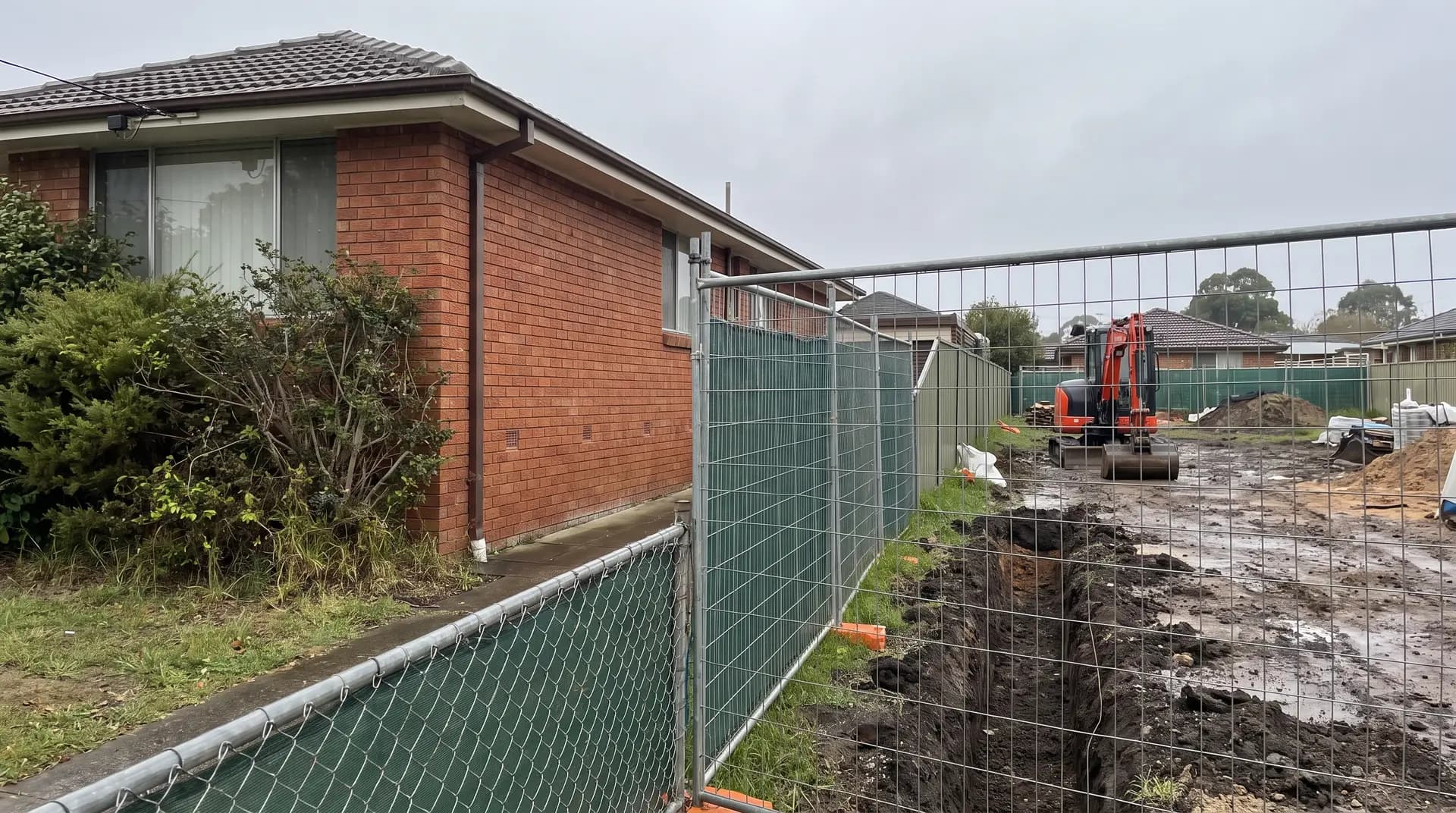
Before any work that moves the ground or shakes it: excavation for a basement or a pool, demolition, piling, compaction, heavy vehicle movement on a shared driveway, or a knock-down-rebuild next door. The pre-construction inspection needs to happen before the first machine arrives, not after the site fence goes up and the excavator has done a day’s work. Then the post-construction inspection happens after the works are complete, ideally before the builder leaves site or the final payment is made, so any change is dealt with while everyone is still involved.
Who can prepare one, and who pays
A building inspector, a building consultant or an engineer prepares dilapidation reports; what matters is that the person is independent of the works and knows how to photograph a defect so it holds up later. On who pays: usually the party doing the works, because it is usually their DA condition and their protection. A neighbour who wants a report commissioned by them and held by them pays for that one. Whether a specific council condition or contract makes someone pay is a question for the condition and for your solicitor.
The builder next door wants to inspect my house: your questions answered
General information, not advice. We’re building and pest inspectors, not lawyers. Access to your property is a legal question under NSW neighbouring-land rules; ask your solicitor before you decide.
Do I have to let them in? That is a legal question and not one we answer. What we can say is that having a record made is in your interest too, because without one you have no before photograph if damage appears.
Can I get my own?Yes. The builder’s report is written for the builder and held by the builder. If you want a report commissioned by you, held by you, and written by someone who works for you, that is a separate booking and the same document.
Who keeps the report?Whoever commissioned it. Ask for a copy of the builder’s report; if they decline, that is a reason to commission your own.
What if cracks appear during the works? Photograph them yourself, dated, straight away. Then the post-construction inspection compares them to the pre-construction record, and the comparison is what goes to the builder, their insurer or your solicitor.
What happens if you don’t get one
The excavation next door finishes. You notice a stepped crack in your side wall and a gap under the fence. You ring the builder, who says the crack was always there; it is a 1950s house on Sydney clay and they all crack. Maybe it was. Maybe it wasn’t. Without a dated photograph of that wall from before the works, there is no way to tell, and the cost of proving it (an engineer, a solicitor, your time) is usually higher than the repair. A dilapidation report costs a fraction of that and turns the argument into a comparison.
Your Side Of The Fence, Documented.
Commissioned by you, held by you, photographed so it can be found again.
How the process works, step by step
- Booking. You tell us the address, who is commissioning the report, what the DA condition says (if there is one) and how many adjoining properties are involved. You get a firm price before anything is booked.
- Pre-construction inspection.Inside and out, element by element, photographed with the room-wall-defect sequence and a scale reference. The roof and the elevations you can’t reach by drone.
- Report delivery. The same day. Dated, organised by area, so anyone can find a specific wall in it later.
- Post-construction inspection. After the works, the same elements re-inspected and compared to the record item by item.
- Resolution. Any change is documented with before-and-after photographs. What you do with that is a conversation with the builder, their insurer or your solicitor.
Dilapidation report vs building inspection vs condition report
| Dilapidation report | Pre-purchase building inspection | Condition report | |
|---|---|---|---|
| Purpose | Prove what existed before nearby works | Tell a buyer what they are buying | Record a property's state at a point in time, often for a lease |
| Assesses defects? | Records them; does not rate severity | Yes: major, minor, safety, with a builder's call on cause | Records them; rarely rates |
| Timber pest? | No | Yes, in the same visit | No |
| Repeated? | Yes: before and after the works | No: once, before exchange | Often at the start and end of a lease |
| Who commissions | The builder (DA condition) or the neighbour | The buyer | The landlord or tenant |
How much a dilapidation report costs in Sydney
It is priced by the number of properties and their size, with the pre-construction report and the post-construction re-inspection quoted together so you know the whole cost up front. A firm price before anything is booked, on the dilapidation reports Sydney page. What changes the price of any inspection is on the inspection cost page. We are based in Smithfield, so Western Sydney, the Hills and the South West, where most of Sydney’s knock-down-rebuilds and greenfield estates are, are the closest drives.