
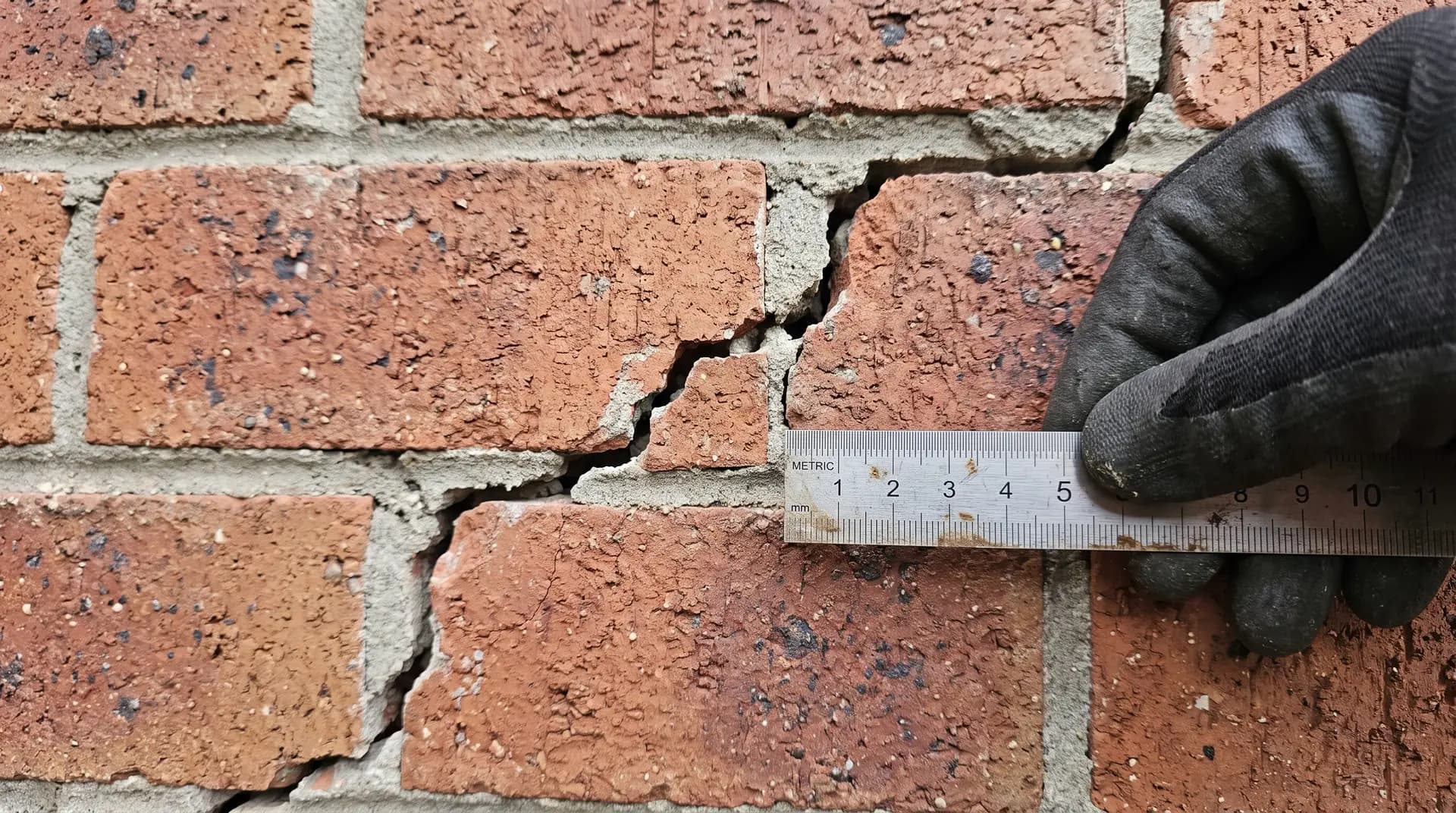
The 30-second check: width, direction, location, movement
Four questions, in order, and they sort most cracks on the spot.
- How wide? Can a credit card edge fit in it? Under about 1mm is hairline. Over 5mm is a crack you can put a coin into, and that is a different conversation.
- Which direction? Vertical, diagonal, stepped through the mortar joints of brickwork, or horizontal. Each points to a different cause, below.
- Where? At the corner of a door or window opening is the commonest and least worrying place. Through a brick wall from the footing up, or at the junction of an extension and the original house, is more telling.
- Is it moving? A crack that was patched and has reopened, or that is wider at the top than the bottom, or that has a sticking door, a sloping floor or a gap under a skirting beside it, is active. A crack that has been painted over 3 times and never reopened is history.
Crack types by direction, and what each usually means
| Crack | What it usually means | Cosmetic or structural? |
|---|---|---|
| Hairline, random, in plaster or render | Shrinkage of the plaster or render as it cured, or normal seasonal movement in the frame. | Cosmetic in almost every case. |
| Vertical, at the corner of a door or window | The opening is the weak point in the wall; movement in the frame or the footing shows up there first. | Usually cosmetic. Watch it if it is wider than a few millimetres or the door sticks. |
| Diagonal, running from a corner of an opening toward the floor or ceiling | Differential movement: one part of the house has moved more than another, typically on reactive clay or where an extension meets the original. | Depends on width and whether it is moving. Over 5mm, or active, is an engineer's question. |
| Stepped through the mortar joints of brickwork | The footing under that part of the wall has moved: clay shrink-swell, a tree drawing moisture, a leaking pipe, or settlement of fill. | The one to take seriously. Width and movement decide; the report rates it and says whether an engineer is needed. |
| Horizontal, in brickwork above a window or door | A rusting steel lintel swelling and lifting the bricks above it, common on the coast and on 1960s to 80s houses. | Not usually a footing problem, but the lintel is failing and needs a builder. |
| Horizontal, along a course of brickwork mid-wall | Wall-tie corrosion letting the outer brick skin move, or a slab or bond beam moving. | An engineer's question if it runs any distance or the wall bows. |
| At the junction of an extension and the original house | The 2 structures are on different footings and move differently. | Usually cosmetic; a flexible joint fixes it. Structural if the gap is wide or growing. |
How wide is too wide: the damage categories in plain English
The Australian residential slab and footing standard classifies cracking in walls into categories by width, as a guide to the damage rather than a diagnosis of the cause. In plain English, and rounded to the bands the standard uses:
| Category | Approximate width | What it looks like |
|---|---|---|
| 0: negligible | Hairline, under 0.1mm | You have to look for it. Not visible from across the room. |
| 1: very slight | Under 1mm | Fine cracks that a coat of paint hides. No treatment needed beyond decoration. |
| 2: slight | Up to 5mm | Visible, and doors and windows may start to stick. Usually filled and repainted; the cause is worth understanding. |
| 3: moderate | 5mm to 15mm, or several cracks over 3mm | Doors and windows sticking, service pipes may be affected, brickwork may need repointing or some replacement. An engineer's opinion is warranted. |
| 4: severe | 15mm to 25mm | Windows and door frames distorted, walls out of plumb, floors sloping, beams losing bearing. Structural work is likely. |
Two cautions. The categories describe width, and width on its own is not the whole story: a 4mm crack that is growing matters more than a 6mm crack that has been stable for 20 years. And the category is a description of damage, not a verdict on the structure; the verdict is an engineer’s. A building inspector uses the bands to rate the finding consistently and to say when the engineer is needed.
Found A Crack In A House You’re Buying? Get It Rated.
A builder’s call on cosmetic vs structural, photographed and explained, the same day. And a clear line on when an engineer is needed.
Why Sydney houses crack: reactive clay and the Cumberland Plain
Much of Western Sydney, from Smithfield and Merrylands through Fairfield and Liverpool to Penrith and Campbelltown, sits on clay soils weathered from Wianamatta shale. Those clays are reactive: they shrink as they dry through a drought and swell again after a wet winter, and a house footing rides that movement up and down by millimetres every year. Over decades that produces the stepped cracking through brickwork, the diagonal cracks from the corners of openings and the doors that stick in winter and free in summer that we photograph on most inspections in the west. The houses most affected are the 1960s to 80s brick veneer on shallow footings, and any house with a large tree close to the footing (the tree draws moisture from the clay and the footing drops toward it), a leaking pipe or downpipe keeping one side wet, or blocked surface drainage. The eastern and northern suburbs on Hawkesbury sandstone crack for different reasons: rusting lintels and wall ties on the coast, and cut-and-fill settlement in the Hills.
The point for a buyer: a stepped crack in a 1975 Blacktown brick veneer is expected, and the question is not whether the clay moved but whether the house has stopped moving with it, or is still going. The Western Sydney and Penrith pages describe the stock in each area.
Cosmetic or structural: how the inspection tells them apart
A crack is 1 symptom. The inspection reads the companions.
- Moisture. The moisture meter and thermal camera check whether a leak or rising damp is keeping the ground under that wall wet, which is the commonest cause of one-sided movement. Drone, thermal camera and moisture meter on every inspection, at no extra charge.
- Doors and windows. A door that has been planed at the top, or a window that will not close, is the frame telling you the wall has moved.
- Floor levels. A fall in the floor toward the cracked wall, or a gap under the skirting, says the footing has dropped.
- External brickwork. The same crack on the outside of the wall, stepped through the mortar, confirms it goes through the structure rather than just the plaster.
- Nail pops and cornice cracks. Plasterboard fixings popping and cornices cracking along a whole wall are the frame moving, not the footing.
- The subfloor. On a piered house, the piers themselves: leaning, cracked, or sitting on wet ground.
When an inspector is enough, and when the report sends you to an engineer
General information, not advice. We’re building and pest inspectors, not structural engineers. The inspection reports what it observes and rates it; adequacy of the structure and the remedy are an engineer's opinion, and the report names the trigger.
An inspector is enough for the great majority of cracks: category 0 to 2, stable, with no companion signs, and the report says so with a photo. The report recommends a structural engineer when a crack is category 3 or wider, when it is clearly active, when it is stepped through brickwork with a sloping floor or a sticking door beside it, when a wall is out of plumb or bowing, or when the cause is not evident. The engineer’s report then gives an opinion on adequacy and a remedy, priced by the trade that does it. That is the path: inspector first, engineer if, never the other way round, and never a quote from a company that sells underpinning as the first opinion.
What “major structural defect” means in a report
In a pre-purchase report, a major defect is one that needs substantial work to fix, or that affects the structure’s performance, safety or the use of the building, as distinct from a minor defect that is cosmetic or maintenance. A structural defect is a major defect in a structural element: footings, walls, floor framing, roof framing, retaining walls. When a report puts a crack in that category it is saying “this is beyond a filler and a coat of paint, and an engineer needs to look at it”, and it goes at the top of the summary page. How the summary separates major from minor is the report explained guide.
Found cracks in a house you are buying? What to do next
- Photograph them yourself with something for scale, and note which wall, before the open home ends.
- Book the inspection and mention them. The inspection reads the companions the open home hides.
- Read the report’s rating. Category 0 to 2 and stable: proceed with the finding priced in. Category 3 or active: the report will recommend an engineer.
- Get the engineer’s opinion inside your cooling-off period if you can, or ask your conveyancer for an extension in writing. The cooling-off guide covers the mechanics.
- Then negotiate, or walk, with your conveyancer. The before or after the offer guide covers using the report.
How to monitor a crack: the pencil-and-date method
For a house you own, or one you are watching: draw a short pencil line across the crack at its widest point and write the date beside it. Do it again in 3 months and after the first heavy rain following a dry spell. If the line has separated, the crack is moving and the amount tells you how fast. If it has not, it is probably history. What movement over 3 months means for the structure is the engineer’s question; the pencil line is what gives the engineer something to work with.
Will insurance cover it
We are not insurers: whether cracking is covered depends on its cause and on your policy, and your insurer or the product disclosure statement is the only reliable answer.