
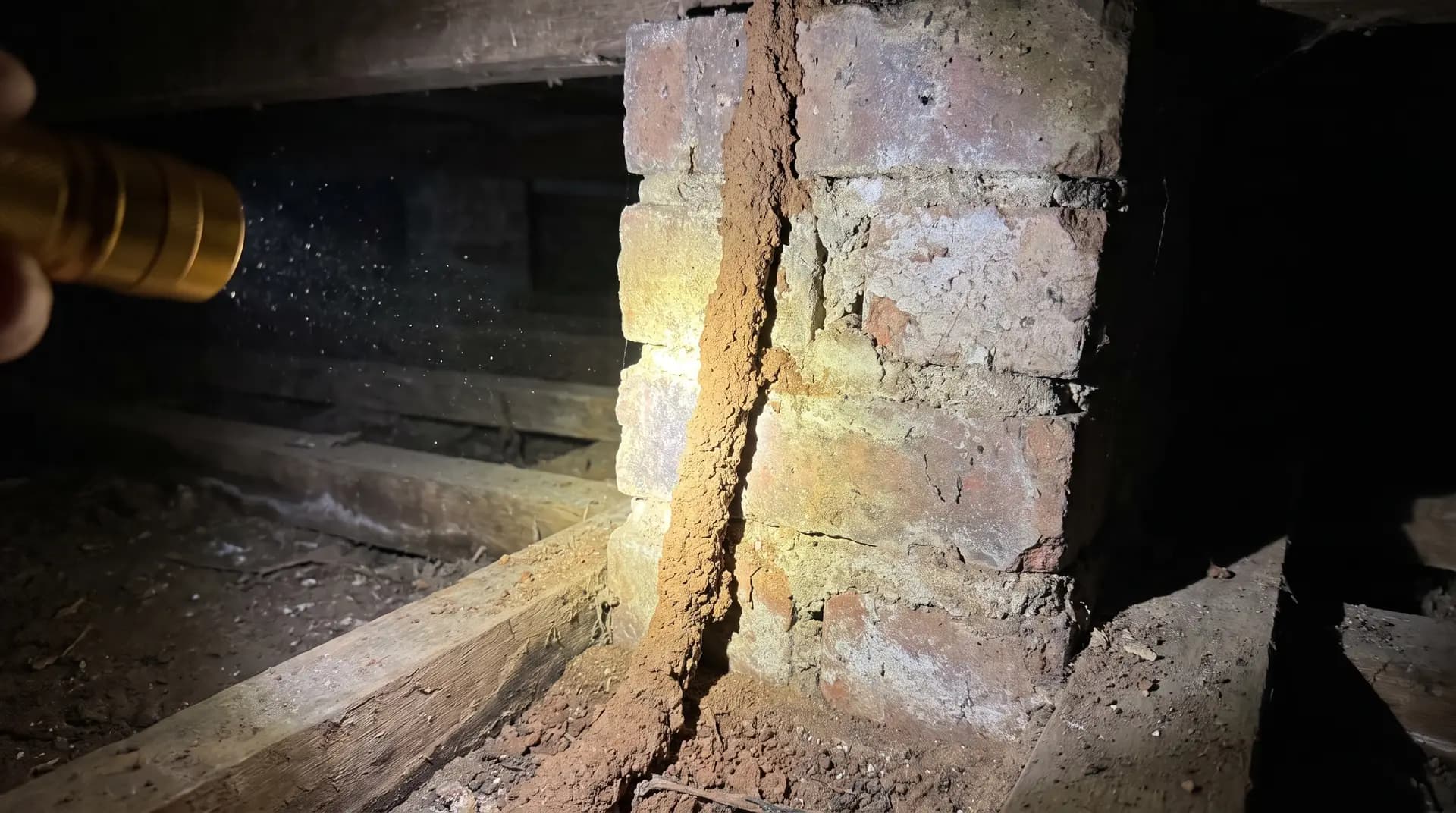
The 8 signs of termite damage
In rough order of how often a buyer can spot them before an inspection.
- Sign 1
Mud leads on piers, the slab edge or brickwork
Pencil-width tubes of soil and saliva that termites build to travel from the ground to the timber without drying out. Up a brick pier in the subfloor, over the slab edge, across a weep hole, up the face of a foundation wall. The single most reliable sign, and the one a buyer can check by looking at the base of the external walls.
- Sign 2
Mud packing in timber joints
The same material packed into the joints between timbers, the ends of joists, the corners of window frames or the gap behind a skirting. Termites seal the workings they are in; the packing is the seal.
- Sign 3
Timber that sounds hollow or papery
Tap a skirting, an architrave, a door frame or a floorboard. Sound timber knocks; termite-eaten timber, which has been hollowed from the inside and left with a paper-thin skin, sounds dull and gives under a screwdriver.
- Sign 4
Bubbling, rippled or sagging paint and plasterboard
Termites eat the paper facing of plasterboard from behind and the moisture they carry lifts the paint. It looks like water damage, which is why the comparison table below matters.
- Sign 5
Doors and windows that suddenly stick
A frame that has been eaten from the inside distorts, and the moisture termites carry swells the timber. Seasonal sticking on Sydney clay is common; a door that stuck suddenly and stays stuck is worth a closer look.
- Sign 6
Sagging or spongy floors
Floorboards, joists or bearers that have been hollowed lose their stiffness. A floor that bounces, dips or feels soft underfoot near an external wall is the sign, and the subfloor is where it is confirmed.
- Sign 7
Discarded wings and alates
On warm, humid evenings, usually after rain in spring and summer, reproductive termites (alates) fly from a mature colony to start new ones, then shed their wings. Piles of identical translucent wings on a sill, in a spider web or under a light means a colony is close.
- Sign 8
Faint clicking or rustling in walls
Soldier termites bang their heads against the tunnel walls when disturbed, and a large colony in a wall can be heard in a quiet room. Rare to notice, and the least reliable sign on its own.
Termite damage, water damage or borers? How to tell them apart
| Clue | Termites | Water damage | Borers |
|---|---|---|---|
| What you see on the surface | Bubbling or rippled paint, paper-thin plasterboard, timber that looks intact but gives | Staining, tide marks, swollen timber, peeling paint, mould | Small round exit holes (1 to 3mm) and fine powdery dust (frass) below them |
| Inside the timber | Hollowed galleries packed with mud, running along the grain | Soft, dark, spongy rot; may crumble | Tunnels with powder; timber stays mostly intact |
| Mud present? | Yes: leads, packing, soil in the galleries | No | No |
| Where | From the ground up: subfloor, slab edge, base of walls, then anywhere timber connects | Below a leak: under wet areas, roofs, windows, at ground level from rising damp | Sapwood of hardwood and softwood, often in floorboards and furniture |
| What the inspection does | Thermal camera and moisture meter find the activity; tapping and the subfloor confirm it; the report names what, where, how much | Moisture readings and the source; see the rising damp guide | Identifies active vs old (fresh frass vs none) and the timber affected |
| Who treats it | A licensed pest manager, from the report | A plumber, roofer or damp specialist, depending on the source | A licensed pest manager if active; often historic and inactive |
Water and termites often arrive together: the moisture is the conducive condition that brought them. The rising damp guide covers the water side.
Which termites do the damage in Sydney
Several subterranean species attack Sydney houses, and they differ in how fast they work and how they are treated. Identifying the species is part of the treatment decision, which is the licensed pest manager's job once the report has established that there is activity and where. What the inspection establishes is the thing that matters first: whether they are in the house, and how far they have got.
Where they get in
- The subfloor: up the piers of a timber-floored house, especially with low clearance and blocked vents.
- The slab edge and weep holes: on a slab-on-ground house, over the edge of the slab where paths and garden beds have been built up against it, and through the weep holes in the brickwork.
- Garden beds against brick: soil above the damp course gives a concealed route straight into the wall cavity.
- Timber in ground contact: verandah posts, pergola posts, retaining wall sleepers, fence posts, the bottom plate of a garage.
- Leaking taps and rising damp: the moisture that keeps the ground and the timber wet enough for a colony to work.
- Trees, stumps and firewood: where the colony often starts, 2 seasons before it reaches the house.
Seen A Mud Lead? Get An Independent Report First.
A timber pest inspection to AS 4349.3-2010, drone, thermal camera and moisture meter on every inspection, at no extra charge. We inspect and report; we don’t sell the treatment.
What not to do when you find them
Do not disturb the workings, spray them, or scrape off the mud leads. The reason is the inspection, not the treatment: termites abandon a disturbed lead within hours and retreat, and the inspection loses the evidence of where they are entering, how far they have got and how active they are. Leave it as you found it, photograph it, and book the inspection. What the pest manager does after that is their licence, not ours.
How a termite inspection finds what you cannot see
- The thermal camera reads the surface temperature of walls and ceilings. Termite activity and the moisture it carries change it, so a nest in a wall or a lead behind plasterboard shows as an anomaly before anything is visible.
- The moisture meter confirms whether the anomaly is wet, and reads the subfloor timbers, skirtings and the base of external walls for the conducive moisture the standard cares about.
- Tapping every accessible skirting, architrave, frame and floorboard for the hollow note.
- The roof void and the subfloor: We inspect the roof void and the subfloor wherever there is safe access, and if we can't get in we say so in the report, and why.
- The drone for the roof timbers at the eaves, the fascia and barge boards, the tops of fences and any timber on the neighbour’s side.
Drone, thermal camera and moisture meter on every inspection, at no extra charge. The scope is on the termite inspection page.
Sydney’s higher-pressure housing stock, by region
- Canterbury-Bankstown and St George: the interwar bungalows and semis on timber floors, with every conducive condition present at once. The highest pressure of our 6 regions.
- Penrith: the older timber-framed stock on the Blue Mountains foothills, next to bushland.
- Northern Beaches: the bush-fringe suburbs adjoining Garigal and Ku-ring-gai Chase, and the weatherboard beach cottages.
After a positive find: the report first, then a licensed pest manager
The report records what, where and how much, with photographs, and the conducive conditions that brought the colony in. That report is what you take to 2 or 3 licensed pest managers for competing treatment quotes, and on a purchase, to your conveyancer before the cooling-off period ends. Because we do not sell the treatment, the report has no reason to lean either way: if the activity is real, you will know its extent before you agree a price, and if there is nothing, that is the finding. Questions to put to the pest manager: which species, where the activity is, which method they propose and why, what ongoing monitoring they recommend, and what their warranty covers.
Why an annual termite inspection matters
A colony reaches a house from the fence line or a stump in a couple of seasons, and the damage it does in the third season is what costs the money. For a house you own in Sydney, a 12-month inspection interval is the general recommendation, and shorter where there is a history of activity, bushland next door or timber in ground contact. The annual inspection is on the termite inspection page; what it costs relative to the repair is on the cost page.